Carpenter in Mobile, AL: Wood Rot, Structure & Finish Work
Mobile Carpentry is a local carpentry shop serving Mobile and the surrounding areas, including Prichard, Chickasaw, Saraland, and Satsuma. For homeowners searching for a carpenter near me in Mobile, we bring the same crew to every job: carpenters who know this building stock, its age, its settling patterns, and the particular way the Gulf Coast climate works on wood. We work on the raised Creole cottages and brick piers of Oakleigh and Church Street East, the Craftsman bungalows under live oaks along Old Dauphin Way, the Victorian townhouses of De Tonti Square, the brick ranches of West Mobile and Tillmans Corner, and the newer homes spreading across Daphne and Spanish Fort. Whether the work is structural, rot and insect damage repair, or finish carpentry and custom built-ins, we start with honest diagnosis and build from there.
This is a carpentry shop, not a franchise. The carpenters who assess your floor, your fascia, or your load-bearing wall are the ones who will repair or replace it. We explain what has happened, why it happened, and what it will cost to make it right. If repair is the honest answer, we repair. If replacement is necessary, we say so plainly. Call us at (251) 333-6112 or request a free wood rot inspection to get started.
Why Wood Fails in Mobile, and How We Read It
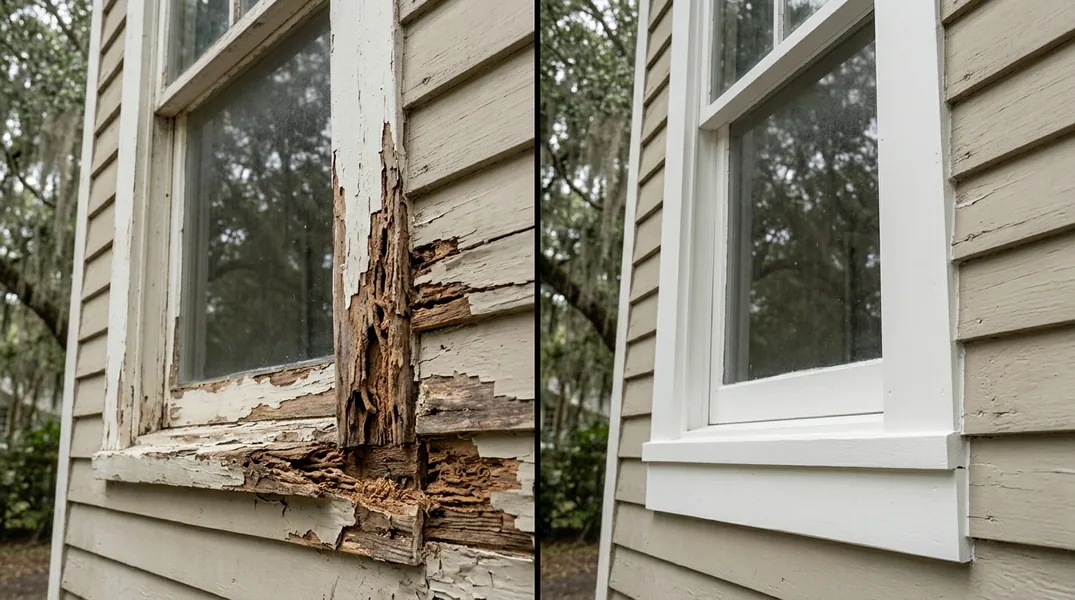
Wood fails in Mobile for reasons rooted in this climate and landscape. The city sits on low, flat, sandy-clay ground at the head of Mobile Bay with a high water table. It is one of the rainiest places in the country, with long, hot, humid summers and almost no hard freeze. That combination means wood stays wet for months at a time. Dry rot is not a matter of standing water but of sustained moisture in the wood itself, which allows a fungus to colonize the fibers and break them down from within. Wet rot settles into sills, window sills, thresholds, and deck ledgers where water pools or runs and cannot dry. Termites, both native subterranean species and the more aggressive Formosan termites, are a well-known problem here. They hollow out sills, floor joists, porch posts, and door frames from the inside while the paint film and the outer shell of the wood remain intact, making the damage invisible until a pest inspection or a probing tool finds it.
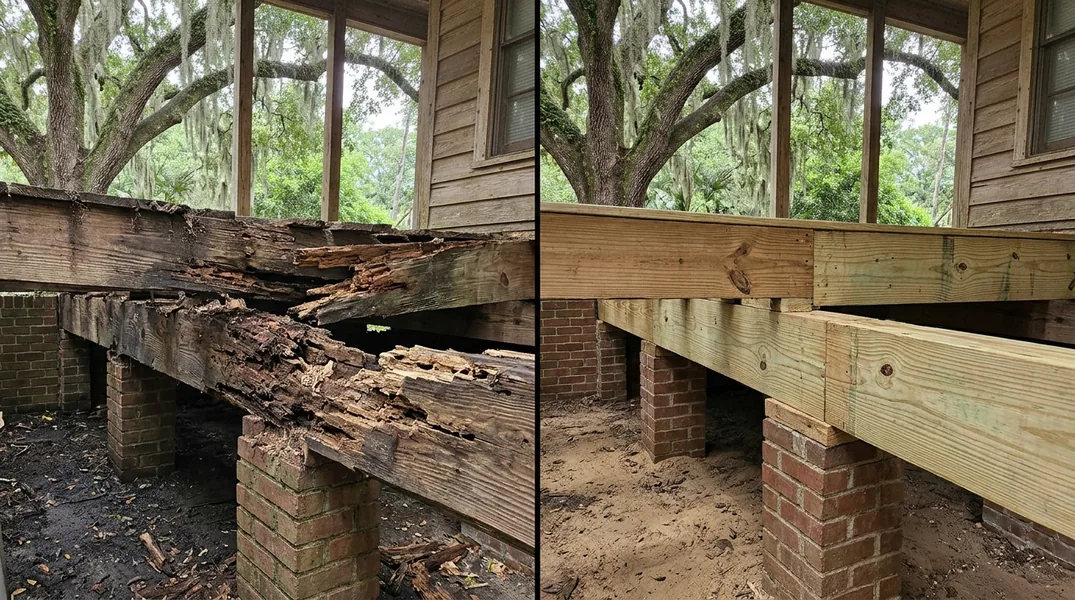
We assess rot and insect damage the same way: by probing to find where sound wood begins, by checking the framing behind the visible surface, and by tracing the water path that fed the decay in the first place. Cosmetic surface decay on a member that still has its structural section can be cut out and rebuilt with new wood, carefully fitted and sealed. A member that has lost too much of its section gets replaced. But here is the honest part: if the water source is not closed, the repair fails again. Caulk and filler over rot is not a repair. It is temporary concealment. We do not treat termites, fumigate, or perform pest control. That is a separate regulated trade. We repair and replace the wood that termites have damaged, working from your own pest inspection report. If you have had a termite inspection done, bring that report to us so we can see exactly what needs to be addressed.
The difference between a repair that holds and one that fails again comes down to one thing: closing the water path. That might mean re-pitching a deck ledger, replacing a window sill with proper slope, or rerouting a gutter. Without it, new wood will rot just as the old wood did. Call (251) 333-6112 to have us look at what you have found, or learn more about wood rot and dry rot repair to understand what you are dealing with.
Structural Carpentry in Mobile: Joists, Beams and Settling
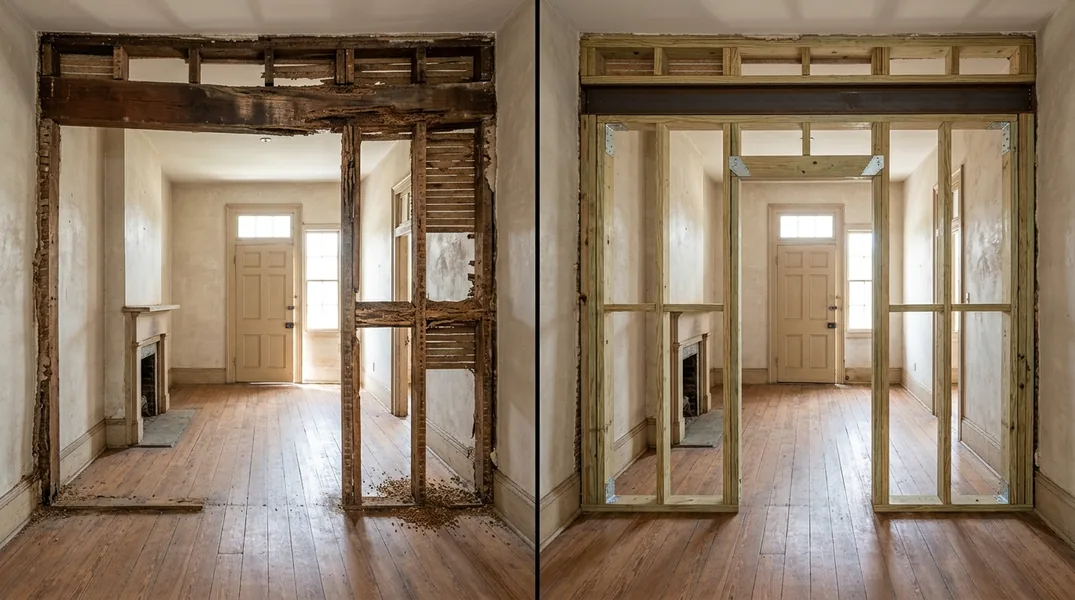
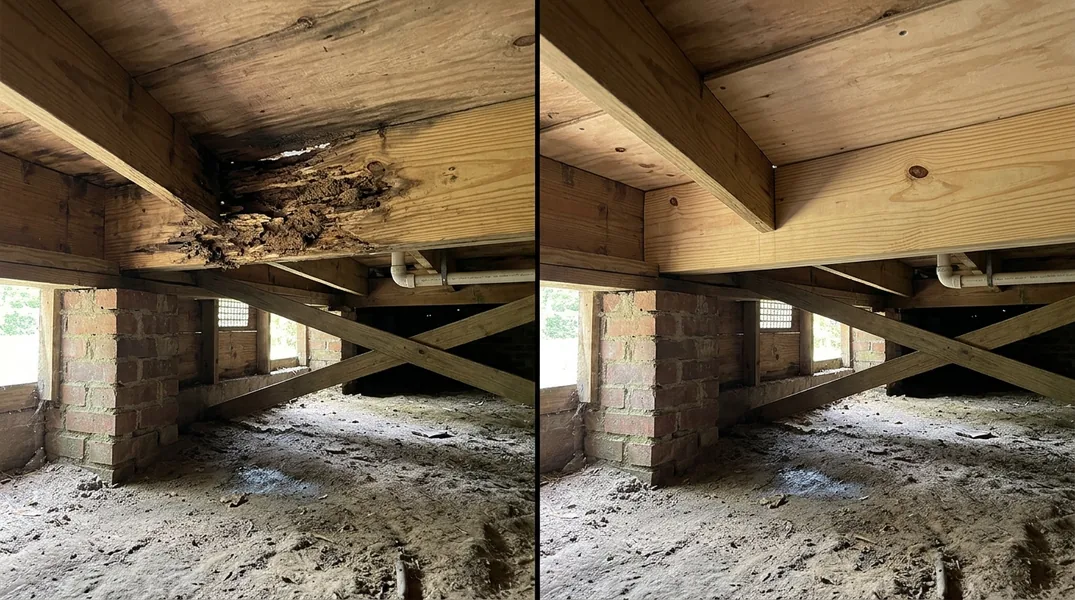
Structural carpentry in Mobile means understanding a century of settling and knowing when to repair and when to replace. A raised cottage or a 1910s bungalow that has settled slowly over decades is in the normal condition for this city. Sloping floors and doors that stick are usually just that: the house finding its rest on its brick piers or sill plate. What matters is whether something is still moving, and whether the members that bear load are still doing their job. If a floor joist has lost section to rot or insects but still has sound wood where it bears, we can sister a new joist alongside it, tying the two together so they work as one. If the joist is too far gone, we replace it. The same logic applies to subfloor sections, sill plates, rim joists, and the headers and beams that carry the load above. We cut out the bad, measure the good, and build what the framing needs to do its job.
Beam sizing and load-bearing wall removal commonly require engineered drawings from a licensed structural engineer and a permit from the local building department. We build to those drawings. We do not produce the drawings ourselves. A permit is commonly required for structural work such as removing or altering a load-bearing wall, replacing beams or joists, or altering stairs or exterior decks, though requirements vary by jurisdiction. Before you start any structural work, check with the Mobile building department to understand what permits apply to your project. Learn more about floor joist and subfloor repair or beam replacement and load-bearing wall removal to see how we approach these jobs.
Finish Carpentry and Built-Ins in Mobile Homes
Finish carpentry in Mobile means working with the building stock as it actually is: bay windows that are out of square, compact floor plans that demand precision, openings that have settled and shifted, and original millwork that is worth matching rather than replacing. We install casing, baseboard, and crown molding with coped joints instead of caulked corners, so the profiles fit tight and look crisp. We scribe trim to walls that are neither flat nor plumb, and we match reveals and profiles to the existing period work in the room. Custom built-ins, shelving, cabinets, and vanities are fitted to the actual dimensions of the space, not the theoretical ones. Interior and exterior doors are hung true and sealed properly. Stairs and railings are built or repaired to code and to the character of the house.
The craft is in the detail: a reveal that is consistent across all the casing in a room, a baseboard that sits flat on a floor that is not, a crown molding that meets at a true coped joint. In a house that is a hundred years old or more, that attention matters. It is the difference between work that looks like it belongs and work that looks like it was glued on. Explore finish and trim carpentry, crown molding and baseboard installation, custom built-ins and shelving, or cabinet and vanity installation to see how we approach these projects.
Permits, Repair-or-Replace & What We Do Not Do
The decision to repair or replace a structural member comes down to a few practical questions: how much sound section is left in the wood, whether the water source that caused the damage can be closed, and how the two costs compare. We quote both options when both are real possibilities, so you can make an informed choice. On permits, requirements vary by jurisdiction and by the scope of work. A permit is commonly required for structural work such as removing or altering a load-bearing wall, replacing beams or joists, or altering stairs or exterior decks. Some jurisdictions have thresholds based on the cost or scope of the work; others do not. Always verify with the Mobile building department before starting your project to understand what permits apply to your work.
We are fully insured and can help you document damage for an insurance claim, though we cannot promise that a claim will be approved or that work will be covered. We do not offer termite treatment, pest control, fumigation, mold testing, or mold remediation. Those are separate regulated trades. We repair and replace wood that has been damaged by rot, insects, or weather, working from your own pest inspection report and your own assessment of the problem. If you are unsure whether your issue is structural, cosmetic, or something in between, contact us for a free wood rot inspection so we can give you a clear picture. Requirements vary, always verify with the Mobile building department before starting your project.