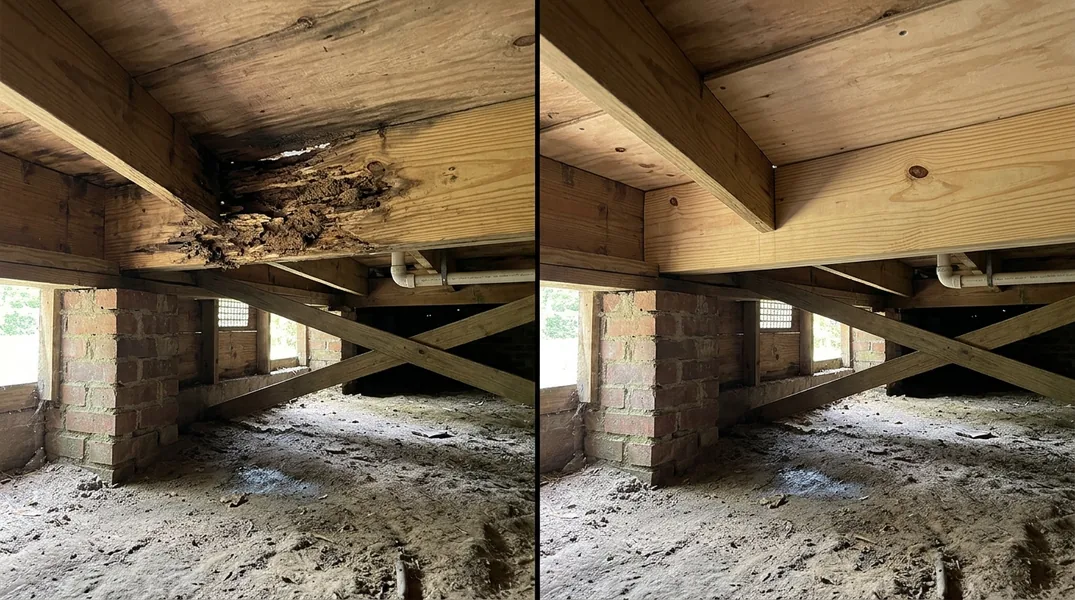
Why Mobile's Raised Cottages Develop Sagging Floors
Mobile's architectural heritage includes countless charming raised cottages, built on brick piers and wooden crawlspaces to handle the region's moisture and seasonal flooding. These homes sit 2 to 4 feet above grade, a design that made sense a century ago. But time, humidity, and the relentless Gulf Coast climate take their toll. If you've noticed your hardwood floors sloping toward the center of a room or doors that stick in their frames, you're experiencing one of the most common structural problems in Mobile area homes.
Sagging floors rarely appear overnight. Instead, they develop gradually as the foundation settles unevenly, floor joists weaken, or support beams lose their structural integrity. The culprit is almost always moisture. Crawlspaces that aren't properly ventilated, brick piers that absorb water, and wooden structural members exposed to dampness create the perfect environment for wood rot and decay. What starts as a small soft spot in a joist can eventually compromise the entire support system beneath your home.
Crawlspace Moisture: The Silent Killer of Floor Joists
The crawlspace beneath a raised cottage is both its greatest asset and its biggest vulnerability. When functioning properly, this gap allows air circulation and protects the home from ground moisture. When it fails, it becomes a damp, dark incubator for wood decay. Many older homes in Mobile were built without vapor barriers, and even newer ones can develop moisture problems if gutters fail, grading slopes toward the foundation, or ventilation louvers become blocked by debris or insulation.
High humidity in the crawlspace promotes wood rot, mold growth, and structural weakening. Floor joists, the horizontal beams that support your floors, are particularly vulnerable because they span the entire width of the crawlspace and absorb moisture from below. Over time, wood that stays damp loses its load-bearing capacity. A joist that once held 1,000 pounds per linear foot might support only half that after rot sets in. This is why Floor Joist & Subfloor Repair is such a critical service in our region. Addressing crawlspace moisture early can prevent thousands of dollars in structural repairs later.
Brick Piers and Foundation Settlement: Understanding the Problem
Raised cottages rest on brick piers, typically laid in mortar and spaced several feet apart around the perimeter and under the home's center. These piers have supported countless Mobile homes through hurricanes and humid summers, but they're not immune to failure. Mortar deteriorates, bricks absorb water and crack, and the soil beneath can settle unevenly as it compacts or washes away. When one pier settles more than its neighbors, the entire floor system above it can sag or develop a noticeable slope.
The problem compounds when moisture penetrates the brick and mortar. Water freezes and thaws in northern climates, but in Mobile's milder winters, the real damage comes from constant dampness that weakens the mortar joints and promotes efflorescence (white salt deposits that indicate internal moisture movement). A pier that was perfectly level in 1950 might be 2 or 3 inches lower today, creating enough deflection to make floors noticeably uneven. Some homeowners accept this as character; others find it structurally concerning and cosmetically frustrating.
Sistering Floor Joists: A Proven Repair Strategy
When floor joists weaken due to rot or become undersized for modern loads, sistering is one of the most effective repair methods. Sistering means installing a new joist alongside the damaged or compromised one, fastening them together so they act as a single, stronger unit. This approach preserves the existing structure while restoring load capacity. For homeowners in Chickasaw and throughout Mobile County, sistering offers a middle-ground solution that's less invasive than complete joist replacement but far more durable than cosmetic patching.
The process begins with a thorough inspection of the crawlspace. Our team identifies which joists show signs of rot, water damage, or deflection. We then select appropriately sized dimensional lumber, position it alongside the damaged joist, and secure it with bolts or lag screws spaced 16 inches apart. The new joist carries the load, allowing the weakened one to gradually shed stress. This method is particularly valuable when Wood Rot & Dry Rot Repair is needed in areas where full removal would be difficult or costly. Once sistering is complete, we address the underlying moisture problem to prevent future decay.
When You Need Beam Replacement and Structural Support
Not every sagging floor can be fixed with sistering alone. If the home's main support beam (the large timber or steel member running under the center of the house) has rotted, shifted, or cracked, the entire foundation system needs reinforcement. Beam Replacement & Load-Bearing Wall Removal is a more complex undertaking, requiring temporary support posts, engineering calculations, and often a structural engineer's stamp. These projects demand precision and experience, especially in older homes where the original construction may not meet modern building codes.
Temporary support is critical during beam work. We install adjustable posts or hydraulic jacks to carry the load of the home while the old beam is removed and the new one installed. This prevents further settling and protects the occupants. Depending on the beam's condition and the home's layout, replacement can take several days to a week. The cost is higher than sistering, but it's essential when the primary support structure has failed. If you suspect your home's main beam is compromised, we recommend scheduling a free estimate to assess the situation.
Sagging Floor Repair Cost in Mobile: What to Budget
The cost of sagging floor repair varies widely depending on the extent of damage, the size of the affected area, and the repair method chosen. A simple sistering job on one or two joists might run $1,500 to $3,500, while a full crawlspace restoration with multiple joist repairs, moisture control, and beam reinforcement could exceed $10,000. Mobile homes built before 1980 often require more extensive work because the original construction used smaller joists and lacked proper moisture barriers. Newer homes in Saraland and surrounding areas may have less severe issues, resulting in lower repair costs.
The best way to understand your specific situation and pricing is to have a professional inspection. Many homeowners are surprised to learn that addressing sagging floors early costs far less than waiting until the problem becomes severe. Water damage spreads, wood rot accelerates, and structural failure becomes increasingly expensive to remedy. Mobile Carpentry offers comprehensive crawlspace evaluations and detailed repair estimates. Call us at (251) 333-6112 or reach out through our website to schedule your assessment today.
Looking for a professional carpentry contractor in Mobile? Mobile Carpentry responds fast for all your carpentry needs.
Get a Free QuoteOur services: Wood Rot & Dry Rot Repair · Termite Damage Repair · Floor Joist & Subfloor Repair